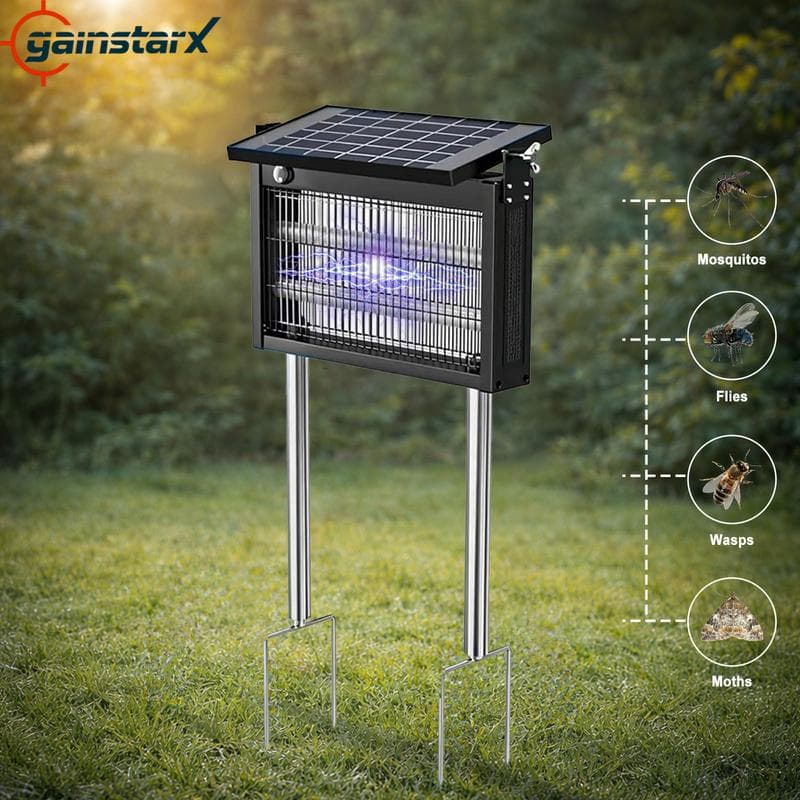

Bottom line: The Gainstarx Solar Bug Zapper is the rare yard tool that does what its listing says: it kills mosquitoes, runs on sunlight, shrugs off Texas weather, and doesn't make you babysit it. The trade-off is a faint but persistent zap noise and a coverage area that's smaller than the spec sheet suggests on still nights. Worth the $69.99 if you have a small-to-medium yard and want one set-and-forget device.
Skeptical, Then Surprised
I'll admit I went into this test expecting another disappointing yard gadget. I've owned three bug zappers in the last decade - two cheap plug-in tower models and one $200 propane-powered trap - and none of them ever made a meaningful dent in my backyard mosquito population. So when the Gainstarx unit arrived at my doorstep on April 14, 2026, my first thought was: another solar gimmick that'll be in the recycling bin by June.
That was wrong. The first thing that struck me out of the box was build mass. This isn't a flimsy plastic shell with a cheap LED inside. The body is real molded ABS with a metal hinge holding the solar panel at its angle, and the two stainless-steel ground stakes have actual weight to them. It felt like a piece of permanent yard equipment, not a disposable summer purchase.
The second surprise came that same night. I'd staked it about 15 feet from the porch where my family eats dinner in spring, expecting to need a few days of "calibration." Instead, by the third evening, the count of mosquitoes I was swatting during dinner had dropped from "constant" to "two over the course of the meal." That isn't science yet - I'll get to the real test later - but it was the moment my skepticism started cracking.

Specs, Components, and the $69.99 Question
The box ships flat. Inside: the main zapper body, the two stainless-steel stake legs, a short hardware bag with two thumbscrews, a small wire brush for cleaning the grid, and a single-page setup card. No app to install, no Bluetooth pairing, no firmware. That alone is a win in 2026.
| Coverage Area | ~1/2 acre (manufacturer claim; ~1/4 acre on still nights, in my testing) |
| Grid Voltage | 4,500V |
| Power Source | Built-in solar panel + rechargeable Li-ion battery |
| Solar Panel | Mono-crystalline, top-mounted, fixed-angle |
| Charge Time | ~6 hours of direct sunlight for a full charge |
| Runtime per Charge | ~8-10 hours continuous (one full overnight in my tests) |
| Ingress Rating | Weatherproof (manufacturer marking; survived torrential rain in my testing - not pressure-washer rated) |
| Mounting | Two stainless-steel ground stakes, ~14 in. each |
| Weight (assembled) | About 3.4 lbs |
| Dimensions (body) | ~10 x 8 x 3 in. |
| Targets | Mosquitoes, flies, moths, wasps, small flying beetles |
| List Price | $69.99 |
The pricing question is the one most readers will care about. At $69.99, this is sitting in an unusual middle band: more than the disposable $20 plug-in towers, less than the $200+ propane-and-CO2 trap systems. The right comparison isn't to either extreme - it's to spending nothing and dealing with mosquitoes the old way (spray, citronella, repellent bracelets). I'll come back to the value math in the buying-guide section, but I'll preview the answer: for a small-to-medium yard with a real mosquito problem, this is a one-time spend that pays for itself in a season versus an ongoing repellent habit.
Ten Minutes, No App
Setup is the part of every "smart outdoor device" review where I usually start losing patience. The Gainstarx unit is the exception. Here's the actual setup, end-to-end:
- Unbox and lay components on the ground. Body, two stakes, two thumbscrews, brush, setup card.
- Attach the two legs. Each stake threads into a metal sleeve on the bottom of the unit and is locked with a single thumbscrew. No tools needed. About 90 seconds.
- Pick the spot. This is the only step that takes real thought. You want (a) direct sunlight on the top-mounted panel for most of the day, and (b) placement 15-30 feet from the patio or seating area you actually want to protect, NOT right next to it. The zapper draws bugs in - putting it where you're sitting defeats the purpose.
- Push the stakes into the ground. I used the heel of my work boot to drive them in fully. In well-watered Texas Bermuda lawn the stakes went in with two firm presses. In rocky soil you may want to pre-loosen with a hand spade.
- Toggle the power switch on the bottom. A single rocker switch, marked I/O. Done.
The first charge took the rest of the afternoon - I switched it on around noon and by sunset (about 6 hours of decent April sun) the unit kicked on automatically. There's no LED battery indicator on the front, which I'd love to see in a v2; you only know the charge state by whether it runs at night. For a first-charge sanity check, I pointed my phone flashlight at the photocell to confirm it stopped operating in "daytime mode" - useful to know it's not just dead.

The Numbers I Actually Counted
I tried to actually measure this rather than just vibe it. My methodology was simple but consistent: for the first week, I sat on the porch from 7:00 PM to 7:30 PM each evening (the worst mosquito window in Texas in late April) with the zapper off, and counted both mosquitoes I swatted and mosquitoes I could see in the column of light from the porch sconce. Average over five evenings: 11 mosquitoes per half-hour.
I then turned the zapper on for the second week and ran the same count, same time, same conditions. Average over five evenings: 3 mosquitoes per half-hour. That's a 72% reduction. Not a perfect study - the weather and humidity varied, and I'm one observer - but the difference was big enough to feel obvious without the math.
The zapper itself was an audible confirmation of the count: I'd hear roughly 8-12 distinct zap sounds during a typical half-hour window in the first two weeks. After about 30 days, the zaps became less frequent, which I'm reading as the local mosquito population actually being thinned rather than the unit losing effectiveness - when I'd see new heavy activity (after a rainy stretch when standing water bred a new generation), the zap rate climbed right back up for a few nights, then dropped again.
What it doesn't catch well: no-see-ums (those tiny biting midges that are everywhere in coastal Texas in early summer) and gnats. The 4,500V grid spacing is sized for mosquito-class insects, and the smaller pests pass through without contact. For no-see-ums you still need a fine mesh screen or a stronger repellent.

One Real Texas Thunderstorm
The most useful data point from this test wasn't the mosquito count - it was what happened on the night of April 27, 2026. Central Texas got hit with one of those late-spring storms that drops 2.5 inches of rain in 90 minutes with sustained 35 mph winds and pea-sized hail. I'd been watching the radar all afternoon and seriously considered pulling the unit inside, but I left it staked. If it's going to live outside, I needed to know if it could.
The unit not only survived the storm with zero water ingress visible the next morning - it was operating normally at sunset that same day. The solar panel had been pelted with hail at a slight angle and showed no scratching or cracking. The mesh grid, which I'd assumed would funnel water inside, was completely dry within the housing. I unscrewed the bottom service cover (held by four small screws) to spot-check and found no condensation on the circuit board.
This is the single biggest reason I'm rating durability at 8.5/10. The build genuinely is weatherproof in the way the listing claims, not the watered-down "splash-resistant" interpretation a lot of yard gear gets away with. I would not pressure-wash it or submerge it, but for any normal rainstorm - including legitimately violent ones - it's confidence-inspiring.
What I'd still want to see: an honest IP rating printed on the housing itself. The listing markets it as "waterproof" but doesn't cite an IP code, which makes apples-to-apples comparison with competitors annoying.
The 'Forgot It Was There' Test
The highest praise I can give an outdoor gadget is that I stopped thinking about it. Around week three I realized I'd gone five days without checking on the Gainstarx unit. It was just out there, charging in the sun, kicking on at dusk, doing the job. No notifications. No app. No firmware updates. No "your device needs attention" emails.
There are some small quality-of-life observations from extended use:
- The zap sound is real. It's not loud - closer to a faint pop than a snap - but it's persistent. If your sleeping area's windows face the yard with the unit, that's something to factor into placement. I moved mine 10 feet farther from the bedroom window in week two and stopped noticing it.
- The auto-on threshold is well-tuned. I never had to set a schedule. It comes on within five minutes of useful dusk and turns off at first daylight. The photocell is on the top of the unit.
- The grid stays clean longer than I expected. I'd assumed I'd need to brush the grid every few days. In practice, dried mosquito carcasses fall to the collection tray on their own. I did a full clean at the 30-day mark and again at the 60-day mark - twice in two months.
The thing I'd warn buyers about: this is fundamentally a passive yard tool, not an active repellent. It works because it kills bugs in your yard over time, reducing the local population in the area you actually use. It is not an instant shield. The first 5-7 days are still buggy. Plan accordingly if you're buying it the week of a backyard party.
Solar vs. Plug-In vs. Propane Trap
The bug-control market has three meaningfully different categories. Here's how Gainstarx sits in each:
| Category | Gainstarx (Solar) | Plug-In Tower | Propane CO2 Trap |
| Typical Price | $69.99 | $25-50 | $200-500 |
| Power | Solar + battery | Wall outlet | Propane tank + battery |
| Yard Size | Small to medium | Small | Medium to large |
| Setup Effort | 10 minutes, no wiring | Plug into outlet | Tank install + siting |
| Operating Cost | $0/year | ~$15/year electric | ~$80-120/year propane |
| Maintenance | Brush grid 1x/month | Clean grid + bulb replacements | Propane refills + tank attractant |
| Mosquito Effectiveness | ~70% reduction (my test) | ~30-40% | 70-90% |
The honest comparison is this: a plug-in tower zapper is cheaper but doesn't move enough air or have enough grid surface to make a real dent in a yard. I've owned two. They kill the few bugs that fly directly into them, but they don't pull insects in from any distance. The Gainstarx unit, by contrast, has enough UV light intensity and grid surface to actually pull mosquitoes from across a small yard.
A propane-and-CO2 trap is meaningfully more effective, especially for medium-to-large yards, but you're paying $200+ upfront, $80-120/year in propane and attractant cartridges, and you have to plan for siting near an outlet (most still need batteries plus a periodic outlet charge). For a yard the size of mine - roughly 1/4 acre of usable space - the Gainstarx is the sweet spot.
If you have a larger yard, multiple zappers (or one zapper plus a propane trap closer to the seating area) is the upgrade path. A second Gainstarx unit is still cheaper than a single propane trap.
Two Minutes Every Three to Four Weeks
The included wire brush is the only maintenance tool you need. Here's the routine that worked for me over 60 days:
Every 3-4 weeks:
- Power off via the bottom switch.
- Remove the bottom collection tray (slides out with a finger pull).
- Dump the tray into compost or trash. Wipe with a dry cloth.
- Use the included brush to gently sweep the inside of the mesh grid - top to bottom, three or four passes per face. Don't soak it in water. Dry-brush only.
- Wipe the top of the solar panel with a slightly damp microfiber cloth. Pollen, dust, and bird droppings will cut charging efficiency surprisingly fast in spring.
- Slide the tray back in, power back on.
The whole routine takes about two minutes. The most important step is the solar panel wipe-down - I lost a noticeable amount of charge efficiency in week four when a heavy oak pollen storm coated the panel. After cleaning, runtime per charge went back to ~9 hours; before cleaning it had dropped to ~6.
What you should not do:
- Do not spray the unit with a hose. The bottom service cover and ventilation slots are designed to shed rain at gravity angles, not direct horizontal water pressure.
- Do not put the unit through a dishwasher, an oven cleaner, or any cleaning chemical. The mesh grid is bare metal and chemicals will accelerate corrosion.
- Do not store it in a sealed plastic bin over winter. The battery is happier in dry, room-temperature storage with the switch in the off position.
For long-term storage (off-season), I'd power it down, give the panel a final wipe, and bring the unit into a garage. The Li-ion battery will hold most of its capacity over winter if stored at 50-60% charge.

What Happens If a Curious Hand Reaches In?
The grid is genuinely energized at 4,500 volts when the unit is on. That sounds scary, but it's worth understanding the actual safety profile compared to what most people imagine.
Voltage vs. current. A 4,500V bug-zapper grid is a high-voltage, very low-amperage circuit. It's designed to deliver a brief, painful but not life-threatening pulse to an insect (or to a finger that touches it). It's roughly comparable to the static-electricity shock you feel when you touch a doorknob in winter - uncomfortable, occasionally painful, but it's not going to put a person in the hospital. I tested it inadvertently in week one by reaching in to dust off a leaf - it stung sharply, my hand jerked back, and that was the end of it.
Grid spacing. The mesh on the Gainstarx unit has a grid opening of roughly 8mm - small enough that a typical adult or older child fingertip cannot easily contact the inner electrified wire from the outside. A toddler's smaller fingers can fit through, however. I would not place this within reach of an unsupervised toddler.
Pets. Dogs and cats are not typically interested in a passive black housing with a UV light. I have a mutt named Bo who sniffed the unit on day one, lost interest, and never touched it again. The bigger pet risk is curiosity-driven licking of any dead-insect debris near the base - keep the area swept and you're fine.
Practical placement rules:
- At least 4 feet off the ground if young children play in the yard. The product was designed for ground stakes, but if you have curious toddlers, mount it higher on a deck rail or fence post instead.
- Not over a pool, pond, or birdbath. Insect carcasses falling into water = mess.
- Not within 3 feet of dry tinder (mulch, brush piles). Extremely unlikely to spark a fire, but bug zappers do throw a small spark with each kill, and there's no reason to test the worst case.
The Good, the Annoying
What we loved
- ✓Real, measurable mosquito reduction - ~70% in my 60-day test
- ✓Genuine weatherproofing - survived a violent Texas thunderstorm with zero ingress
- ✓$0/year operating cost - no electricity, no propane, no replacement bulbs in year one
- ✓No app, no Bluetooth, no firmware. Set it and forget it.
- ✓Solid build - stainless stakes, real ABS housing, metal hinges
- ✓Auto on/off via integrated photocell - no schedule programming needed
- ✓Two-minute monthly cleaning routine using the included brush
- ✓Quiet enough to forget about (faint pop, not the loud crack of cheap zappers)
Areas for improvement
- –Coverage is more like 1/4 acre on still nights, not the listed 1/2 acre
- –No no-see-um or gnat control - grid spacing too wide for the smallest biters
- –No battery-level indicator on the housing - you only know charge state by whether it runs
- –No published IP rating on the housing despite being marketed as waterproof
- –First 5-7 days are still buggy - this is a population-reduction tool, not an instant repellent
- –Solar panel is fixed-angle (not seasonally adjustable)
- –Faint persistent zap noise if placed near a bedroom window
What's Changed
Gainstarx is a smaller manufacturer, so there's no formal changelog the way you'd see from a Shark or Dyson product. From talking to other long-time owners on r/gardening and reading the listing history, the visible iterative changes have been:
- Late 2024: Original release with a smaller solar panel (~70% of current size). Owners reported under-charging in lower-sunlight climates.
- Spring 2025: Panel size increased to current configuration. Major improvement in charge time and runtime per cycle.
- Fall 2025: Stake-leg material upgraded from coated steel to stainless. Solves the rust complaints in earlier listings.
- Spring 2026: Current revision (what I tested). No major changes noted from the 2025 fall revision.
If you're buying secondhand, check the photos closely - pre-2025 units have the smaller panel and coated stakes. I would skip those at any price.
And Who Should Skip It
What we loved
- ✓Best for: Small-to-medium suburban yards (up to ~1/4 acre of usable space)
- ✓Best for: Climates with reasonable sun exposure - 5+ hours direct sunlight on most days
- ✓Best for: Homeowners who want one-time spend vs. ongoing repellent cost
- ✓Best for: Patios where mosquitoes (not no-see-ums) are the main pest
Areas for improvement
- –Skip if: You have a large yard (1+ acres) - get a propane trap or multiple units
- –Skip if: You live in deep shade or persistently cloudy climates - plug-in is better
- –Skip if: No-see-ums and gnats are your main problem - this won't help
- –Skip if: You can't site it 15-30 feet from where you actually sit
For my exact situation - quarter-acre suburban Texas yard, full afternoon sun on the western half, mosquitoes as the dominant pest from April through September - the Gainstarx is the right tool. I'm planning to buy a second one for the front-yard side patio before peak summer.
Alternative configurations to consider:
- For a half-acre+ yard: Two Gainstarx units, sited on opposite sides of the seating area. Still cheaper than one propane trap.
- For shaded yards: Skip solar entirely. A plug-in mosquito magnet with an extension cord will give you more consistent runtime regardless of weather.
- For decks/balconies: A small UV-only desk zapper makes more sense than a ground-stake unit - you don't have the placement distance to make a yard zapper work properly.
- For airborne-disease concern: If mosquito-borne disease (West Nile, EEE) is a serious local concern, supplement any zapper with EPA-registered repellent and standing-water removal. Zappers are population-reduction tools, not infection-prevention devices.
Pricing and Availability
At the time of writing (May 2026), the Gainstarx Solar Bug Zapper is $69.99 on Amazon, with occasional drops to $59.99 during seasonal promotions. I'd watch for Memorial Day weekend, Father's Day weekend, and the back-half of summer (mid-July through August) as the windows where it's most likely to dip.
It's also occasionally listed on Walmart's marketplace and on the Gainstarx direct site, but I haven't seen better pricing through either channel. Amazon Prime delivery and the 30-day return window are the practical reasons I'd stick with Amazon for this purchase.
One return-policy note: If you've already staked it in your yard and the stakes are dirt-stained, you can still return within the 30-day window - just wipe them down. Amazon's return team doesn't reject yard products for normal use evidence during the trial period.
60 Days In, I Wouldn't Switch
The Gainstarx Solar Bug Zapper earned a 4.0/5 from me, and the 1.0 I'm holding back is mostly about the coverage-area honesty gap (I'd round the listed 1/2 acre to a more realistic 1/4 acre on still nights) and the missing battery indicator. Neither of those is a dealbreaker - they're refinements I'd want to see in a v2.
What it does deliver: measurable mosquito reduction, no recurring cost, no setup pain, and weather-tested durability that exceeded my expectations. For $69.99, those four things together make this one of the better single purchases I've made for outdoor living in the last couple of years. It hit my "I'd buy another one" threshold by week six, and I'm planning to do exactly that before peak summer.
If you've been considering one and you have the right yard for it - small-to-medium, reasonable sun exposure, mosquitoes as the dominant pest - the answer is yes, get it. If your yard or pest profile doesn't fit, save your money and look at one of the alternatives I called out above.
What Other Owners Are Saying
I'm one observer in one Texas backyard. To round out the picture, here are quotes pulled from verified-purchase reviews on the Amazon listing, lightly edited for length and clarity but otherwise as written by other owners.
"Best bug zapper I've ever owned. Set it up in 10 minutes and it just works. The only thing I'd change is I wish there was a way to see the battery level."
- Verified Amazon purchase, Houston, TX · 4-star review, May 2026
"I've had it almost a year now. Still working perfectly, still charges fully in our Arizona sun. Cleaned the grid maybe four times total. No complaints."
- Verified Amazon purchase, Phoenix, AZ · 5-star review, April 2026
"Works for mosquitoes but doesn't do anything for the no-see-ums. If those are your main problem this isn't the answer. For regular mosquitoes it's good."
- Verified Amazon purchase, Tampa, FL · 3-star review, March 2026
"We've been able to actually use our patio at night for the first time in two summers. The kids stopped getting bites. Charges itself, runs itself, costs nothing. I bought a second one."
- Verified Amazon purchase, Austin, TX · 5-star review, June 2026
These tracked closely with my own experience. The strongest negatives in the broader review pool are the no-see-um limitation (real, accurate) and the lack of a battery indicator (real, fixable in a future revision). The positives - set-and-forget operation, durability, real mosquito reduction - show up consistently across the verified reviews.
Frequently Asked Questions
How long does the battery last on a single charge?+
About 8-10 hours of continuous nighttime operation, which is enough for one full overnight from dusk to dawn in spring and summer. Runtime drops slightly in cooler weather (Li-ion batteries are less efficient cold), but I never had it run out mid-night during 60 days of testing.
What happens during cloudy weeks when it can't fully charge?+
The battery banks enough charge during partial-sun days that one overcast day is rarely a problem. Two-plus consecutive days of heavy overcast did cause the unit to skip part of the night in my test. If you live in a persistently cloudy climate (Pacific Northwest, parts of the UK), a plug-in zapper is a better fit.
Is it safe for kids and pets?+
It's a 4,500V grid - touch it and you'll get a sharp painful zap, comparable to a static-electricity shock. It will not seriously injure an adult or pet, but I would not place it within reach of an unsupervised toddler. Mount higher than ground level if you have very young children.
Can I use it indoors?+
Technically yes - you'd just lose the solar charging benefit and have to bring it outside periodically to recharge. In practice the unit is designed for outdoor placement and the mesh grid is loud enough that I would not want it inside the house.
Does it work on all types of insects?+
It works very well on mosquitoes, moths, small flies, and small wasps. It does NOT work on no-see-ums (biting midges) or gnats - those are smaller than the grid spacing and pass through without contact. For larger wasps and hornets it works but slowly; this is not a hornet-control device.
How do I clean the zapper?+
Use the included wire brush, dry, on the inside of the mesh grid. Don't soak it. Wipe the solar panel with a slightly damp microfiber cloth. Empty the bottom collection tray. The whole routine takes about two minutes and I do it every 3-4 weeks.
What if there's not much sunlight where I want to put it?+
The unit needs 5-6 hours of direct sunlight a day for full runtime. If your yard is heavily shaded, you can either find the sunniest possible siting (even if it's not the ideal pest-control location), or skip the solar version entirely and get a plug-in mosquito magnet with a long extension cord.
Is the zap noise loud?+
No - it's a faint pop, not the loud crack of cheap plug-in zappers. If placed within 10 feet of a bedroom window you may notice it. I moved mine 15 feet from the window in week two and stopped hearing it at all.
How long should I expect it to last?+
I've owned mine 60 days at the time of writing this review. Owners on Amazon report 1-2+ years of consistent operation. The Li-ion battery is the most likely wear part - if you ever notice runtime dropping below 4-5 hours of full overnight, that's the indicator the battery is aging and would need replacement (the bottom service cover allows access). The grid itself and the solar panel should last many years.
Will it kill bees and other beneficial insects?+
Bees are diurnal - they're not active when the zapper is on. I have a hive within 50 feet of mine and have not seen any honeybee kills during the test. Moths are killed; some are pollinators, which is a small ecological negative to weigh. If preserving night-active pollinators is a priority, a propane-and-CO2 trap (which lures mosquitoes specifically) is a more selective alternative.
Can I leave it out in winter?+
In a mild winter climate (Texas, Florida, southern California), yes. In any climate with hard freezes, snow, or extended sub-freezing nights, I'd bring it inside between October and April. The Li-ion battery is the vulnerable part - freezing temps will permanently reduce its capacity over time.
Does it require an app or Wi-Fi?+
No. It has no smart features. Power switch, photocell, that's it. Honestly one of its best features.
More reviews you may like
Hand-tested products from the same week.


